
What Is a Traveling Grate Steam Boiler and How Does It Work?
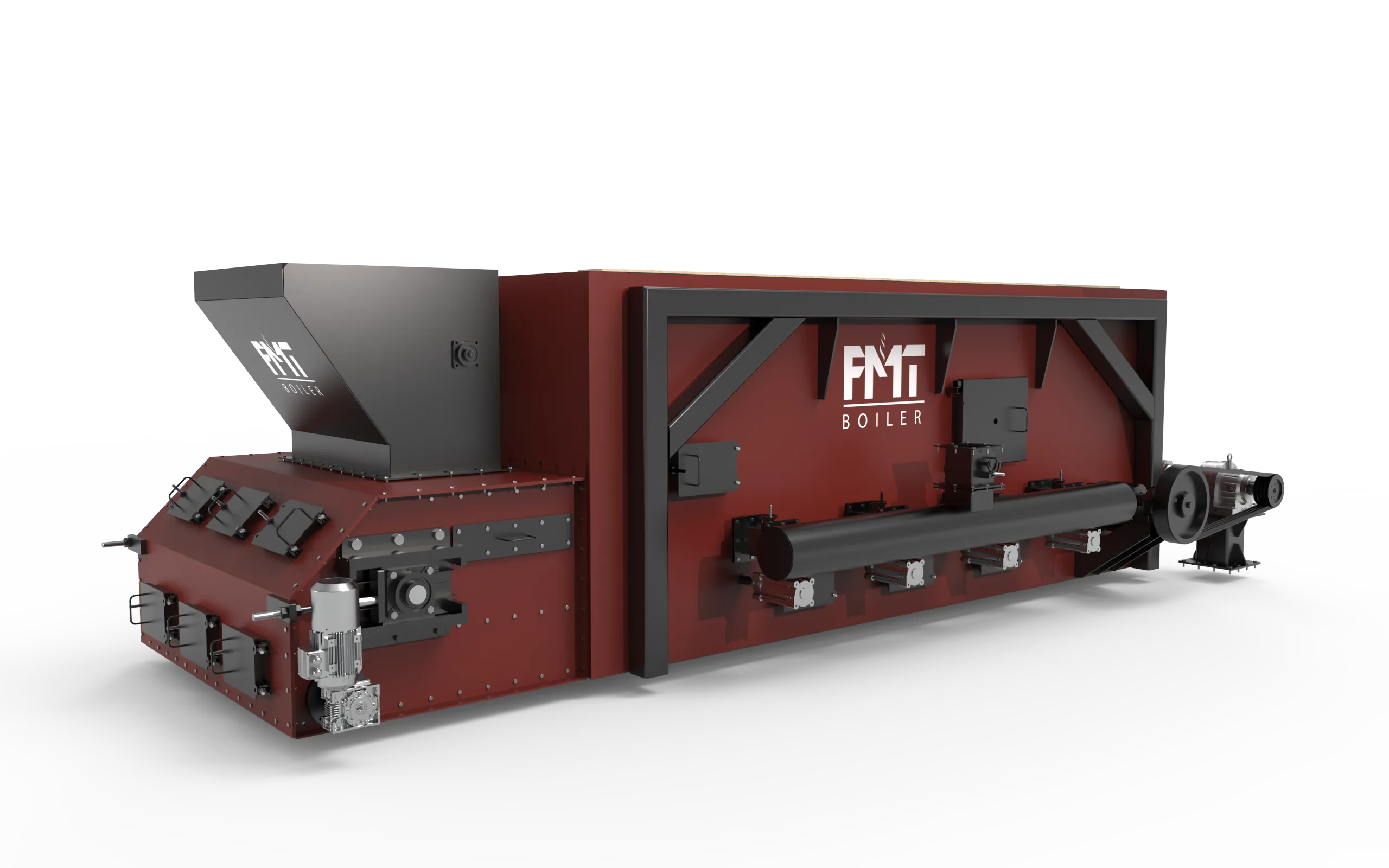
For facilities that need to produce large quantities of steam continuously using solid fuels such as coal and biomass, one of the most widely preferred solutions is a traveling grate steam boiler. This article explains what a traveling grate is, how combustion takes place inside the furnace, which fuels it can handle, and what to consider when choosing a boiler.
What Is a Traveling Grate Steam Boiler?
A traveling grate steam boiler is a solid-fuel steam boiler in which fuel is carried through the furnace on a continuously moving chain grate and burned completely along the way. The grate moves like an endless belt made of interconnected cast sections: its upper surface carries fuel from the front to the rear of the furnace, while its lower surface returns empty. For this reason, the system is also known as a chain grate or conveyor grate.
Because fuel feeding, combustion, and ash removal all take place continuously through the same movement, traveling grate boilers are fully automatic systems that require very little operator intervention.
How Does a Traveling Grate Boiler Work?
Fuel is conveyed from the storage area by an auger or conveyor to the service hopper at the front of the boiler. An adjustable gate beneath the hopper controls the thickness of the fuel bed spread over the grate. As the grate advances, the fuel passes through four zones in sequence:
- Drying zone: Heat radiated by the hot refractory wall (radiant arch) at the front of the furnace drives moisture out of the fuel.
- Gasification zone: As the temperature rises, volatile matter in the fuel is released as gas. These gases are burned in the furnace volume with secondary air supplied above the grate.
- Fixed-carbon combustion zone: The remaining coke burns on the grate with primary air supplied from beneath it.
- Ash zone: Once combustion is complete, the ash drops into the ash hopper at the end of the grate and is removed by an automatic ash extraction system.
Since the air ducts beneath the grate are divided into compartments, each zone can receive the amount of primary air it needs. The grate speed is also adjusted using a frequency inverter, so the fuel's residence time in the furnace can be matched to its combustion rate. The returning grate sections are cooled by primary air away from the flame, which gives the grate a long service life.
Correct Settings, High Efficiency
Three settings determine the efficiency of a traveling grate: fuel bed thickness, grate speed, and the distribution of air between zones. If unburned fuel falls into the ash hopper, the grate may be moving too fast or the fuel bed may be too thick; if the flame dies out at the beginning of the grate, the grate may be moving too slowly.
Which Fuels Can Be Used?
The traveling grate's greatest advantage is its fuel flexibility. Its wide grate surface and long combustion path allow the following fuels to be burned efficiently:
- Coal: lignite and imported coal, especially fine-grained and screened coal,
- Biomass: agricultural and forestry residues such as sawdust, wood chips, hazelnut shells, and olive pomace,
- Low-calorific, economical fuels: fuels with high moisture or volatile content and low density.
When selecting fuel, consider not only the price but also its moisture content, particle size, calorific value, and ash fusion temperature. For fuels with a low ash fusion temperature, the furnace is designed to prevent slag formation. For this reason, laboratory analysis of the intended fuel is recommended before the boiler is designed.
Traveling Grate or Stoker?
The two combustion systems most often compared for solid-fuel steam boilers are the traveling grate and the stoker:
| Feature | Traveling Grate | Stoker (Underfeed) |
|---|---|---|
| Fuel feeding | Fuel is spread over the grate and carried forward | Fuel is pushed into the furnace from below by an auger |
| Fuel flexibility | High; can also burn moist, fine-grained, and low-calorific fuels | More limited; requires fuel with a specific particle size and quality |
| Ash removal | Continuous and automatic at the end of the grate | Automatic or periodic, depending on the system |
| Typical application | Facilities with continuous, high steam demand | Smaller and medium-capacity facilities |
In short, if your fuel varies or you want to use inexpensive, low-calorific fuel, a traveling grate is a strong choice; if your fuel is consistent and your requirements are more modest, a stoker combustion system may be a better fit. Compare all the options on our solid-fuel steam boilers page.
What to Consider When Choosing a Traveling Grate Steam Boiler
- Steam demand and pressure: Determine your hourly steam consumption, peak instantaneous demand, and operating pressure.
- Fuel analysis: The grate area, furnace volume, and air system should be sized according to the analysis of the fuel you will use.
- Fuel storage and feeding: The storage area, hopper, and auger capacity should support uninterrupted operation.
- Flue gas treatment: Systems such as a cyclone and wet scrubber should be planned to meet emission limits.
- Heat recovery: You can reduce fuel consumption by heating the feedwater with an economizer and the combustion air with a recuperator.
- Automation: Inverter-driven fans, automatic dampers, and automatic level control support safe and efficient operation.
- Service and spare parts: The ease of replacing grate sections and the availability of spare parts have a long-term impact on costs.
You Can Retrofit Your Existing Boiler with a Traveling Grate
Buying a new boiler is not the only option for businesses looking to reduce fuel costs. A traveling grate combustion system can be installed on existing steam, hot water, and thermal oil boilers with a suitable body. The boiler body, furnace dimensions, and intended fuel are assessed together before the retrofit.
FMT Boiler CGS Series
FMT Boiler's CGS Series traveling grate combustion system burns coal and biomass efficiently with chrome-alloy ductile iron grate sections, fully automatic fuel feeding and ash removal, inverter-driven primary/secondary fans, and a design tailored to each project. For details and a quotation, visit our traveling grate steam boiler page.